
You Can read this in : Marketingwithanshika
What Is Instacart AI Assistant?
Instacart is bringing artificial intelligence into everyday grocery shopping with its new AI-powered assistant, Clementine. Introduced on September 9, 2026, Clementine is now available to customers across the U.S. and Canada through the Instacart Marketplace. Instead of making shoppers search for every product one by one, the Instacart AI assistant lets them describe what they need in a simple conversation and can turn that request into a personalized shopping cart.
So, what is Instacart AI assistant in practical terms? It is a grocery-focused AI tool designed to help with meal planning, recipe discovery, grocery lists, product recommendations, and reordering. For example, a shopper could ask for budget-friendly lunches for a week, quick dinners for two, or their usual pantry items. The assistant can then suggest relevant products and create a cart based on the request.
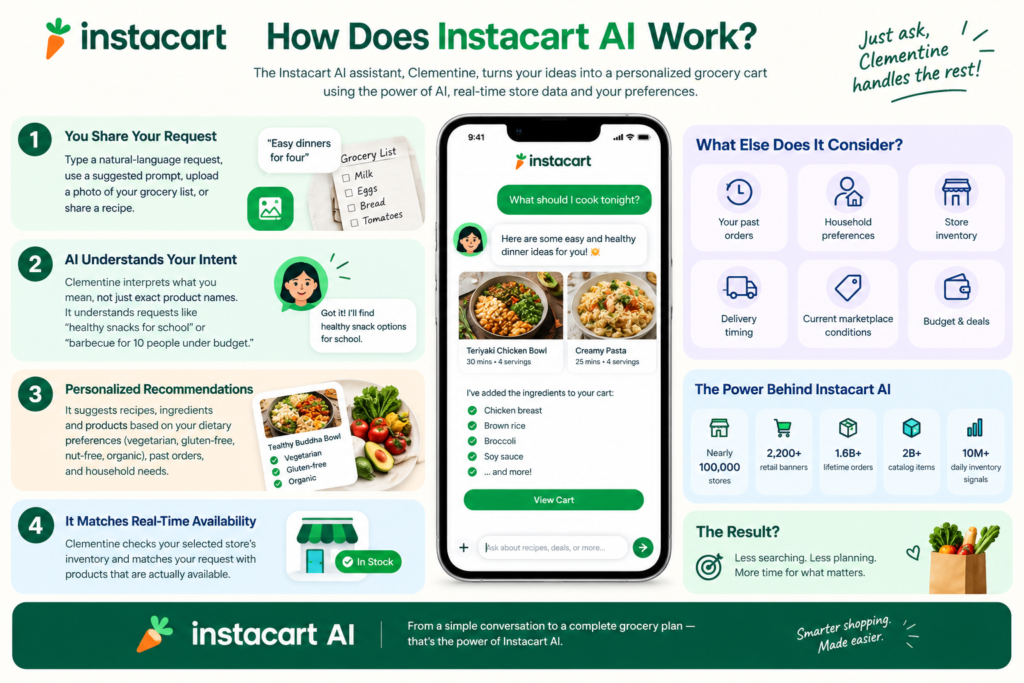
One of the main features of the Instacart AI assistant is its ability to work with real-time store availability. Instacart says Clementine is supported by data from nearly 100,000 stores, more than 2,200 retail banners, over 1.6 billion lifetime orders, and more than 2 billion items in its catalog. The company also receives more than 10 million daily inventory signals, helping the assistant understand what may actually be available at a customer’s selected store.
Another useful feature is personalization. What is Instacart AI assistant without considering how different households shop? Clementine can take preferences such as vegetarian, gluten-free, nut-free, or organic choices into account. It can also surface relevant deals, suggest lower-cost alternatives, recreate regular shopping lists, and turn a photo of a handwritten or digital grocery list into items that can be added to a cart.
The goal is simple: make grocery shopping less time-consuming and reduce the effort involved in deciding what to buy. Instacart reports that more than 80% of Americans surveyed said figuring out what to make for dinner causes them stress, while more than three in five said they would be interested in an AI assistant that could help.
In short, how does Instacart AI work is closely connected to understanding a shopper’s request, preferences, available products, and shopping history. By combining these elements, the Instacart AI assistant aims to turn a vague idea—such as “What should I cook tonight?”—into a practical grocery plan and ready-to-buy cart.
How Does Instacart AI Work?
The Instacart AI assistant is designed to make grocery shopping feel more like having a conversation than performing a long product search. Customers can interact with Clementine through the Instacart app or website by typing natural-language requests, using suggested prompts, or uploading a photo of a grocery list. For example, a shopper can ask for “easy dinners for four,” request ingredients for a specific recipe, or ask for deals on their usual products. Clementine then turns that request into a shopping list or personalized cart.
So, how does Instacart AI work when a shopper makes a request? The system first interprets the intent behind the conversation instead of relying only on exact product names. A request such as “healthy snacks for school” can be understood as a need for suitable grocery products rather than a single item. The assistant can also work with uploaded handwritten lists, digital screenshots, recipes, meal ideas, and occasion-based requests. This makes the Instacart AI assistant useful even when shoppers do not know exactly what products they want.
Another important part of how does Instacart AI work is product and recipe recommendation. Clementine can generate personalized recipe ideas or surface recipes from trusted publishers, then identify the ingredients needed for those recipes. Those ingredients can be matched with products available through the shopper’s selected retailer. Customers can also ask for dietary preferences such as vegetarian, gluten-free, nut-free, or organic options, allowing recommendations to become more relevant to individual households.
The Instacart AI assistant also considers information that can change the shopping experience, including previous orders, household preferences, store inventory, delivery timing, and current marketplace conditions. Instacart says Clementine is supported by more than 1.6 billion lifetime orders, over 2 billion catalog items, nearly 100,000 stores, and more than 10 million daily inventory signals. This large grocery data foundation helps the system connect a user’s request with products that may actually be available.
Budget is another part of the process. Shoppers can ask for budget-friendly meals, deals, promotions, or lower-cost alternatives. For example, someone planning a barbecue for 10 people under a specific budget can ask the assistant to build a suitable list. Clementine can also use past order history for requests such as “shop my usuals” or “restock my pantry staples.”
Overall, how does Instacart AI work comes down to combining natural-language understanding, personalization, recipes, shopping history, budget needs, and real-time product availability. The result is an Instacart AI assistant that aims to reduce the amount of searching and planning shoppers have to do before placing an order.
Why Is Instacart Using Shrek and Scooby-Doo?
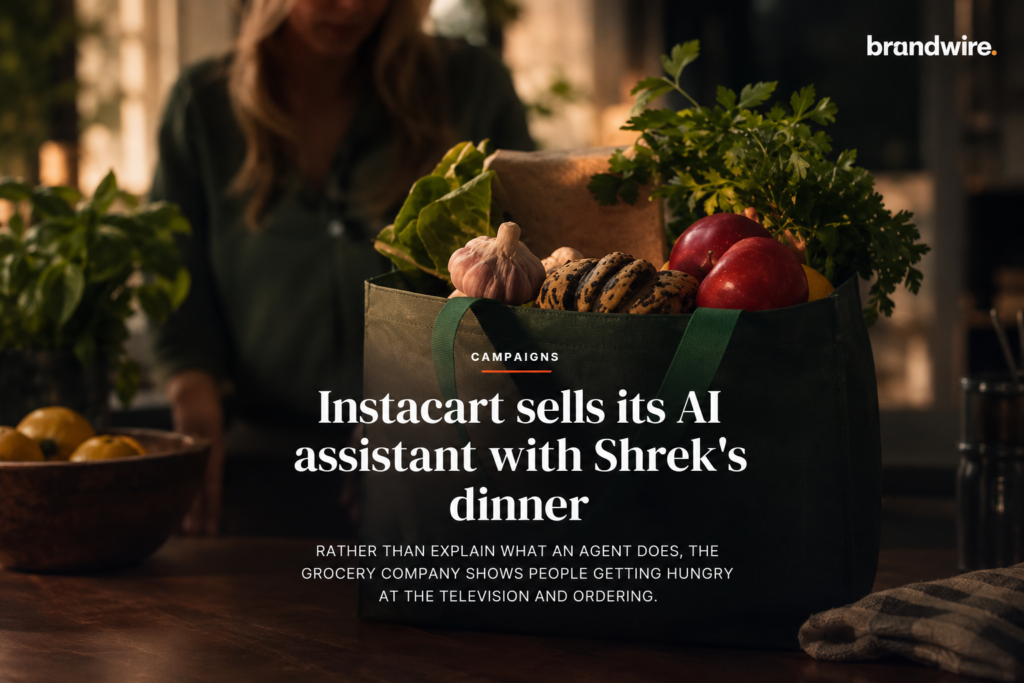
Instacart is using familiar characters such as Shrek and Scooby-Doo to make its new AI shopping assistant, Clementine, easier to notice and understand. Rather than explaining AI with technical language, the campaign starts with something people already recognize: memorable food scenes from popular movies and television shows. The idea connects a familiar entertainment moment with a real grocery need, showing how an idea can quickly become an order.
So, why is Instacart using Shrek and Scooby-Doo instead of focusing only on the technology? The characters provide an immediate cultural reference point. In the campaign, four ads feature scenes from Shrek, Scooby-Doo, The Office, and A Charlie Brown Thanksgiving. Viewers see food-related moments from these shows or movies and then watch the characters’ meals or cravings inspire a grocery-shopping idea.
The Shrek and Scooby-Doo campaign also demonstrates what Clementine can actually do. In one advertisement, a scene from Shrek inspires a viewer to think about making a one-pan dinner. She then turns to Clementine, which generates a butternut squash risotto recipe. Another ad uses Scooby-Doo’s famous food-focused world to create a different grocery inspiration. This makes the technology easier to understand because viewers can see the complete journey from entertainment to meal idea to shopping cart.
This is an important part of why is Instacart using Shrek and Scooby-Doo: entertainment becomes a product demonstration rather than simply a celebrity-style appearance. The characters attract attention, but the AI assistant remains the main focus. The campaign shows that shoppers do not always begin with a specific product in mind. Sometimes they begin with a craving, a meal they saw, or simply the question of what to eat.
The campaign’s central message is “Turn any idea into an order.” The ads launched across several channels, including linear television, streaming or OTT, YouTube, audio, social media, influencer content, and Instacart’s own app. The first campaign activity also appeared during NBC’s Sunday Night Football, giving the concept a broad television audience.
Ultimately, why is Instacart using Shrek and Scooby-Doo comes down to making a new technology feel familiar and practical. Instead of presenting Clementine as complicated AI, Instacart shows a simple human behavior: see something appealing, get an idea, and decide what to eat. By connecting that moment to an AI-powered shopping experience, the Shrek and Scooby-Doo campaign gives consumers a more relatable way to understand what Clementine can do.
I
Is Instacart AI Helpful?
The Instacart AI assistant is designed to reduce some of the most time-consuming parts of grocery shopping, especially deciding what to buy and turning that decision into an organized cart. Instead of searching for products individually, shoppers can describe what they need in natural language, upload a grocery list, or ask for ideas. Instacart says Clementine can turn a conversation, recipe, or grocery list into a personalized cart in seconds.
One major benefit of the Instacart AI assistant is faster meal planning. A shopper can ask for easy dinners for a family, high-protein meals for two, or budget-friendly lunches for a week. Clementine can generate personalized recipes or surface options from trusted publishers and create a shoppable ingredient list. This can reduce the time spent deciding what to cook and then searching for every ingredient separately.
The Instacart AI assistant can also suggest products and alternatives based on household preferences and store availability. For example, users can specify preferences such as vegetarian, gluten-free, nut-free, or organic. If a preferred product is unavailable, the system can surface alternatives instead of simply leaving an item off the list. Instacart says its system is supported by more than 2 billion catalog items, nearly 100,000 stores, and more than 10 million daily inventory signals, helping recommendations reflect what may actually be available at a selected retailer.
Budgeting is another useful feature. Shoppers can ask for deals on their usual products, find lower-cost alternatives, or create a shopping plan around a specific budget. For example, Instacart describes requests such as preparing everything needed for a backyard barbecue for 10 people under $100. The assistant can also use previous order history to help customers reorder regular household
How Can AI Help With Grocery Shopping?
AI is changing how people approach everyday grocery shopping by helping with tasks that usually require several searches, decisions, and lists. An Instacart AI assistant such as Clementine can take a simple request and turn it into useful shopping suggestions. Instead of starting with individual products, shoppers can begin with an idea, recipe, budget, or grocery list and let AI organize the next steps.
One of the simplest ways how can AI help with grocery shopping is by creating grocery lists. A shopper can describe what they need for a particular meal, event, or week, and AI can organize the required ingredients. Instacart’s Clementine can also work with uploaded grocery lists, including photos, helping users turn existing lists into products that can be added to their cart. This can be particularly useful when shoppers have a long list and want to reduce manual searching.
AI can also help people find products quickly. Rather than searching for every item separately, users can describe what they are looking for in everyday language. The Instacart AI assistant can interpret the request and recommend relevant products from available retailers. Instacart says its marketplace covers nearly 100,000 stores and more than 2 billion catalog items, giving its AI system a large product base to work with.
Meal planni
What Makes Instacart’s AI Campaign Different?
Instacart’s latest campaign takes a different approach to promoting AI by combining new technology with characters that audiences already recognize. Instead of presenting Clementine through a traditional technology-focused advertisement, Instacart places its AI assistant inside familiar pop-culture moments. The campaign features characters and scenes from Shrek, Scooby-Doo, The Office, and A Charlie Brown Thanksgiving, connecting entertainment with everyday meal decisions.
One of the most noticeable elements is the use of Shrek and Scooby-Doo to attract attention. Both characters are strongly associated with memorable food-related scenes, making them a natural fit for a grocery brand. In the Shrek advertisement, a viewer watches Shrek eating an unusual meal and gets inspired to make a one-pan dinner. She then uses Clementine to create a butternut squash risotto recipe. The Scooby-Doo advertisement similarly takes inspiration from the oversized sandwiches associated with Scooby-Doo and Shaggy.
This approach also helps make AI easier for everyday shoppers to understand. Rather than explaining complicated AI features, the advertisements show a simple journey: see something → get an idea → ask Clementine → create a meal → build a shopping cart. That makes the technology’s purpose more concrete. Instacart says Clementine can turn a conversation, recipe, or grocery list into a personalized cart, using information such as household preferences, budgets, and real-time product availability.
The campaign also reflects a wider shift in creative marketing to promote AI. As AI becomes part of more consumer products, brands need to explain not only what the technology is but also why ordinary people should use it. Instacart’s campaign focuses on a familiar problem—deciding what to eat—and uses entertainment to demonstrate how AI can help solve it. The campaign’s central message, “Turn any idea into an order,” connects inspiration directly with shopping.
The campaign is also designed to reach people across several channels. Instacart launched the campaign during NBC’s Sunday Night Football and planned distribution across linear television, streaming/OTT, YouTube, audio, social media, and its own in-app channels. This gives the campaign multiple opportunities to reach consumers in different digital and entertainment environments.
Overall, Instacart’s strategy shows how creative marketing to promote AI can focus on experiences instead of technical explanations. By combining AI with recognizable entertainment characters, Instacart makes Clementine feel connected to an everyday activity rather than presenting it as complicated technology. The result is a campaign that demonstrates what the AI assistant does while using familiar stories and characters to make the message easier to remember.
Conclusion
The Instacart AI assistant, Clementine, shows how artificial intelligence is moving beyond simple search and becoming part of everyday grocery planning. Launched across the U.S. and Canada in September 2026, Clementine can turn a conversation, recipe, or grocery list into a personalized cart. It can help shoppers plan meals, find products, identify deals, discover lower-cost alternatives, and reorder regular items. Instacart says the system is supported by more than 1.6 billion lifetime orders, over 2 billion catalog items, more than 10 million daily inventory signals, and nearly 100,000 stores across North America.
The Instacart AI assistant also became the center of an unusual marketing campaign featuring familiar characters such as Shrek and Scooby-Doo. Instead of explaining AI through technical features alone, the campaign shows people getting meal inspiration from popular entertainment and then using Clementine to turn those ideas into something they can actually shop for. The campaign’s message, “Turn any idea into an order,” connects entertainment, food inspiration, and AI-powered shopping in a simple way.
The growing role of AI in grocery shopping is not limited to Instacart’s consumer app. Instacart is also offering Cart Assistant, a customizable AI shopping tool that retailers can use on their own websites and apps. The company says retailers including Food Bazaar, Heritage Grocers Group, and Woodman’s are already live with the technology, while additional retailers are planned to follow. Instacart has also partnered with AI platforms including OpenAI, Anthropic, and Google so grocery-related conversations can move from those AI services to Instacart for ordering.
Looking ahead, AI-powered shopping could become more personalized and connected to the way households actually plan their meals. Instead of searching item by item, shoppers may increasingly describe an occasion, dietary preference, budget, or meal goal and receive a ready-to-review cart. Instacart’s current technology already moves in this direction by combining shopping history, preferences, promotions, recipes, and live inventory.
Ultimately, the Instacart AI assistant represents a shift from simply finding groceries to helping people decide what to buy and why. AI is not replacing the shopper’s final decision; rather, it is becoming a tool for reducing the time and effort involved in planning. As these systems develop, the future of grocery shopping could involve more conversational, personalized, and AI-assisted experiences from meal inspiration all the way to checkout.
