The Rise of AI Search: What Zero-Click Searches Mean for Digital Marketers.

The Rise of AI Search: What Zero-Click Searches Mean for Digital Marketers.

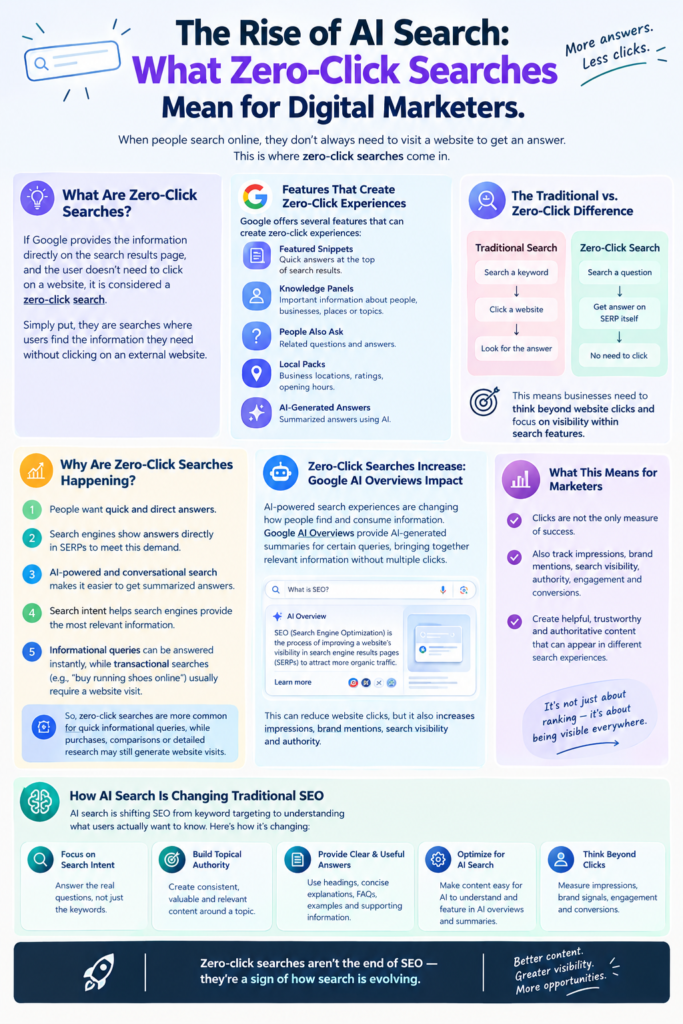
Read this on –Marketingwithanshika When people search online, they don’t always need to visit a website to get an answer. This is where zero-click searches come in.  If Google provides the information directly on the search results page, and the user doesn’t need to click on a website, it is considered a zero-click search. So, what are zero click searches? Simply put, they are searches where users find the information they need without clicking on an external website. Google offers several features that can create zero-click experiences. Featured Snippets provide quick answers at the top of search results, while Knowledge Panels show important information about people, businesses, places, or topics.  People also ask answers related questions, and Local Packs display details such as business locations, ratings, and opening hours. AI-generated answers are also becoming an important part of this search experience. Understanding what zero click searches are important because they are changing traditional search behavior. Earlier, users usually searched for a keyword, clicked a website, and then looked for the answer.  Today, search engines can provide much of that information instantly, making the process quicker and more convenient. The biggest difference between traditional and zero-click searches is the user’s next step. Traditional searches often encourage users to click through to a website, while zero-click searches can satisfy their search intent directly on the results page. This means businesses need to think beyond website clicks and focus on visibility within search features. For digital marketers, understanding what zero click searches are becoming increasingly important. SEO is no longer just about achieving a high ranking.  Marketers also need to create clear, useful, and trustworthy content that search engines can understand and potentially feature in different search experiences. Why Do Zero-Click Searches Happen? People today want quick and direct answers. Instead of visiting several websites for a simple question, users prefer finding the information they need instantly on the search results page. Search engines are designed to meet this demand by showing answers directly in SERPs (Search Engine Results Pages). Features like Featured Snippets, Knowledge Panels, People Also Ask, and Local Packs help users get information without clicking a website. The growth of AI-powered and conversational search is making this experience even more common. AI can understand natural-language questions and provide summarized answers, reducing the need for users to browse multiple websites. Search intent also plays an important role. When search engines understand what a user wants, they can provide the most relevant information directly in the results. For example, an informational search like “What is SEO?” can often be answered directly through a Featured Snippet or AI-generated response. However, a transactional search such as “buy running shoes online” usually requires users to visit a website, compare options, and make a purchase. This is why zero-click searches are more common for quick informational queries, while searches involving purchases, comparisons, or detailed research may still generate website visits. Zero-Click Searches Increase: Google AI Overviews Impact AI-powered search experiences are changing how people find and consume information online. Instead of scanning multiple search results, users can increasingly get direct and summarized answers within the search experience. Google AI Overviews provide AI-generated summaries for certain queries, bringing together relevant information to help users understand a topic without immediately visiting several websites. This creates a more convenient search experience and changes how users interact with traditional organic results. As these AI-powered answers become more common, zero-click searches can potentially affect organic website clicks and traffic. When users get enough information directly from the search results, they may have less reason to click on individual websites, particularly for simple informational queries. However, clicks are not the only measure of online visibility. Impressions, brand mentions, search visibility, and authority are becoming increasingly important. Being referenced or recognized within search experiences can help users discover and remember a brand, even when they do not immediately visit its website. For digital marketers, this means SEO measurement needs to go beyond traditional rankings and clicks. Marketers should also monitor search impressions, branded searches, conversions, engagement, and overall visibility to understand how their content performs in an AI-driven search environment. The rise of Google AI Overviews does not make SEO irrelevant; instead, it encourages marketers to create helpful, trustworthy, and authoritative content that can remain visible across evolving search experiences. How AI Search Is Changing Traditional SEO AI search is changing SEO from simply targeting keywords to understanding what users actually want to know. Instead of creating content around individual keywords, marketers now need to focus on search intent and provide useful information that genuinely answers the user’s question. Topical authority is becoming increasingly important. Websites that consistently create valuable and relevant content around a specific subject can demonstrate deeper knowledge and become a stronger source of information for both users and search engines. Content also needs to provide clear and useful answers. Well-structured headings, concise explanations, FAQs, examples, and relevant supporting information can make content easier to understand and more useful for people searching for answers. With the growth of conversational AI search, users are asking questions in a more natural way. Marketers should therefore optimize content for conversational searches, including longer and question-based queries that reflect how people actually speak and search. Finally, credibility and expertise matter more than ever. Businesses should create original, accurate, experience-based content and clearly demonstrate their knowledge. In the AI search era, successful SEO is increasingly about being a helpful, trustworthy, and authoritative source, rather than simply achieving a high keyword ranking. How to Optimize for Zero-Click Searches in 2026 To stay visible in zero-click searches, marketers need to create content around real user questions and conversational keywords rather than focusing only on traditional keywords. Give clear and direct answers to common questions. Use proper headings, short paragraphs, bullet points, and FAQs to make content easy for both users and search engines to understand. Building topical authority is also important. Consistently publishing accurate, helpful content can strengthen your website’s expertise and trustworthiness while supporting E-E-A-T

The Rise of AI Search: What Zero-Click Searches Mean for Digital Marketers. Read More »
Instacart AI Launches a New Assistant with Shrek & Scooby-Doo

Instacart AI Launches a New Assistant with Shrek & Scooby-Doo

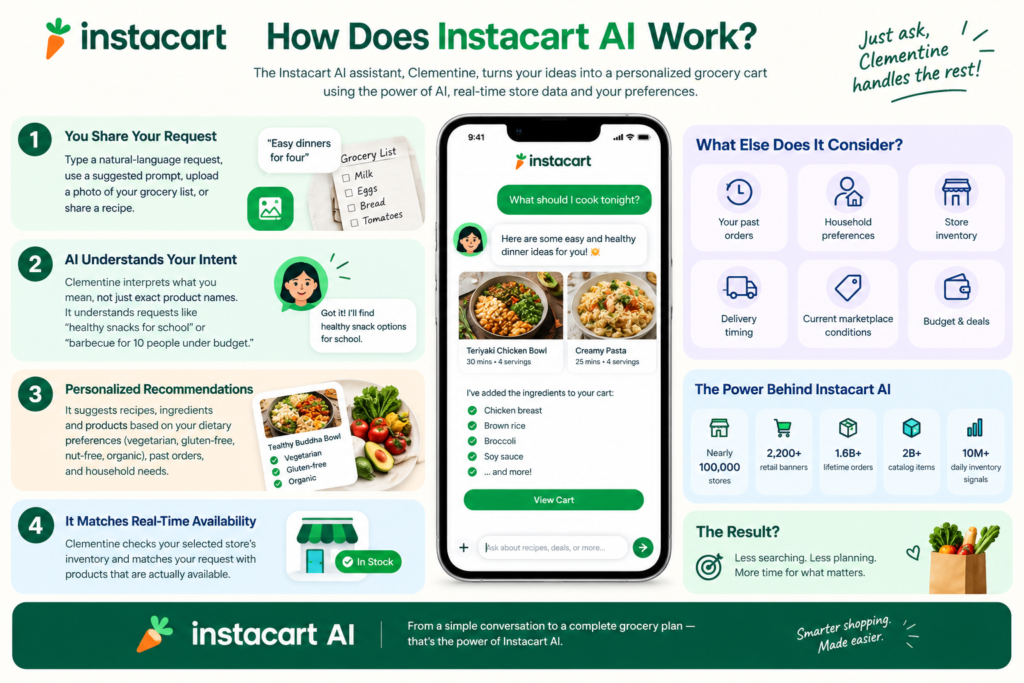
You Can read this in : Marketingwithanshika What Is Instacart AI Assistant? Instacart is bringing artificial intelligence into everyday grocery shopping with its new AI-powered assistant, Clementine. Introduced on September 9, 2026, Clementine is now available to customers across the U.S. and Canada through the Instacart Marketplace. Instead of making shoppers search for every product one by one, the Instacart AI assistant lets them describe what they need in a simple conversation and can turn that request into a personalized shopping cart. So, what is Instacart AI assistant in practical terms? It is a grocery-focused AI tool designed to help with meal planning, recipe discovery, grocery lists, product recommendations, and reordering. For example, a shopper could ask for budget-friendly lunches for a week, quick dinners for two, or their usual pantry items. The assistant can then suggest relevant products and create a cart based on the request. One of the main features of the Instacart AI assistant is its ability to work with real-time store availability. Instacart says Clementine is supported by data from nearly 100,000 stores, more than 2,200 retail banners, over 1.6 billion lifetime orders, and more than 2 billion items in its catalog. The company also receives more than 10 million daily inventory signals, helping the assistant understand what may actually be available at a customer’s selected store. Another useful feature is personalization. What is Instacart AI assistant without considering how different households shop? Clementine can take preferences such as vegetarian, gluten-free, nut-free, or organic choices into account. It can also surface relevant deals, suggest lower-cost alternatives, recreate regular shopping lists, and turn a photo of a handwritten or digital grocery list into items that can be added to a cart. The goal is simple: make grocery shopping less time-consuming and reduce the effort involved in deciding what to buy. Instacart reports that more than 80% of Americans surveyed said figuring out what to make for dinner causes them stress, while more than three in five said they would be interested in an AI assistant that could help. In short, how does Instacart AI work is closely connected to understanding a shopper’s request, preferences, available products, and shopping history. By combining these elements, the Instacart AI assistant aims to turn a vague idea—such as “What should I cook tonight?”—into a practical grocery plan and ready-to-buy cart. How Does Instacart AI Work? The Instacart AI assistant is designed to make grocery shopping feel more like having a conversation than performing a long product search. Customers can interact with Clementine through the Instacart app or website by typing natural-language requests, using suggested prompts, or uploading a photo of a grocery list. For example, a shopper can ask for “easy dinners for four,” request ingredients for a specific recipe, or ask for deals on their usual products. Clementine then turns that request into a shopping list or personalized cart. So, how does Instacart AI work when a shopper makes a request? The system first interprets the intent behind the conversation instead of relying only on exact product names. A request such as “healthy snacks for school” can be understood as a need for suitable grocery products rather than a single item. The assistant can also work with uploaded handwritten lists, digital screenshots, recipes, meal ideas, and occasion-based requests. This makes the Instacart AI assistant useful even when shoppers do not know exactly what products they want. Another important part of how does Instacart AI work is product and recipe recommendation. Clementine can generate personalized recipe ideas or surface recipes from trusted publishers, then identify the ingredients needed for those recipes. Those ingredients can be matched with products available through the shopper’s selected retailer. Customers can also ask for dietary preferences such as vegetarian, gluten-free, nut-free, or organic options, allowing recommendations to become more relevant to individual households. The Instacart AI assistant also considers information that can change the shopping experience, including previous orders, household preferences, store inventory, delivery timing, and current marketplace conditions. Instacart says Clementine is supported by more than 1.6 billion lifetime orders, over 2 billion catalog items, nearly 100,000 stores, and more than 10 million daily inventory signals. This large grocery data foundation helps the system connect a user’s request with products that may actually be available. Budget is another part of the process. Shoppers can ask for budget-friendly meals, deals, promotions, or lower-cost alternatives. For example, someone planning a barbecue for 10 people under a specific budget can ask the assistant to build a suitable list. Clementine can also use past order history for requests such as “shop my usuals” or “restock my pantry staples.” Overall, how does Instacart AI work comes down to combining natural-language understanding, personalization, recipes, shopping history, budget needs, and real-time product availability. The result is an Instacart AI assistant that aims to reduce the amount of searching and planning shoppers have to do before placing an order. Why Is Instacart Using Shrek and Scooby-Doo? Instacart is using familiar characters such as Shrek and Scooby-Doo to make its new AI shopping assistant, Clementine, easier to notice and understand. Rather than explaining AI with technical language, the campaign starts with something people already recognize: memorable food scenes from popular movies and television shows. The idea connects a familiar entertainment moment with a real grocery need, showing how an idea can quickly become an order. So, why is Instacart using Shrek and Scooby-Doo instead of focusing only on the technology? The characters provide an immediate cultural reference point. In the campaign, four ads feature scenes from Shrek, Scooby-Doo, The Office, and A Charlie Brown Thanksgiving. Viewers see food-related moments from these shows or movies and then watch the characters’ meals or cravings inspire a grocery-shopping idea. The Shrek and Scooby-Doo campaign also demonstrates what Clementine can actually do. In one advertisement, a scene from Shrek inspires a viewer to think about making a one-pan dinner. She then turns to Clementine, which generates a butternut squash risotto recipe. Another ad uses Scooby-Doo’s famous food-focused

Instacart AI Launches a New Assistant with Shrek & Scooby-Doo Read More »

OpenAI’s Latest AGI Update Explained

OpenAI’s Latest AGI Update Explained 

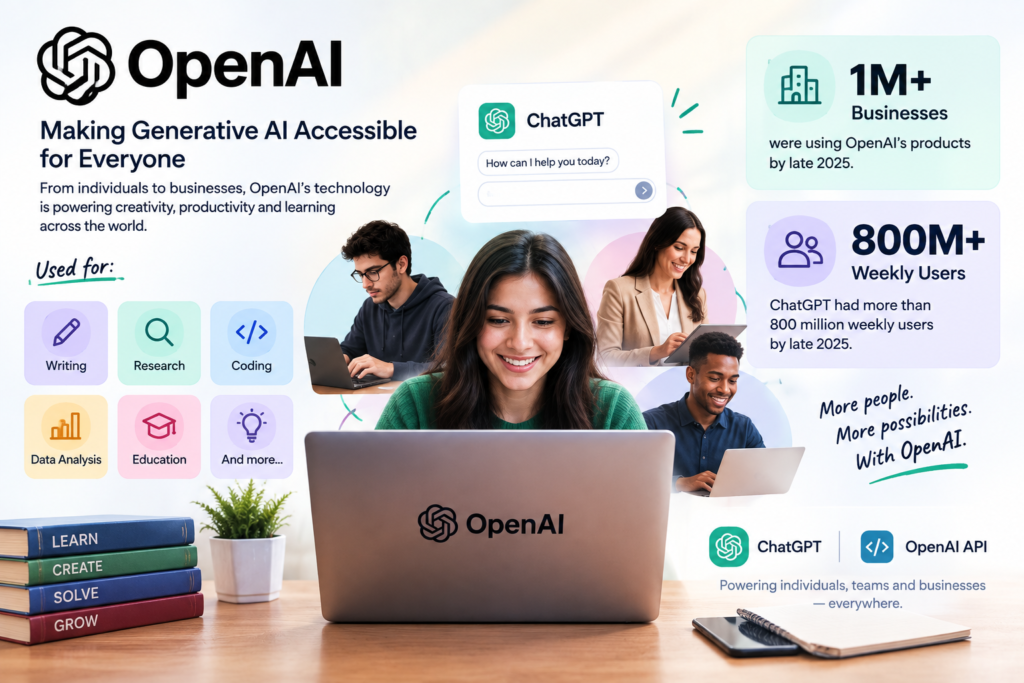
In Marketing with Anshika, You will read about it. OpenAI is an artificial intelligence (AI) research and technology company focused on developing advanced AI systems. Its stated mission is to ensure that artificial general intelligence (AGI) benefits humanity. OpenAI’s research covers areas such as reasoning, multimodal AI, frontier models, and the safe deployment of AI. So, what is OpenAI in simple terms? It is a company that builds AI models and products designed to understand information, generate content, solve problems, write and debug code, analyze data, and assist people with everyday and professional tasks. What Does OpenAI Do? OpenAI develops AI models that can work with different types of information, including text and images. Its models are used through products such as ChatGPT and developer tools available through the OpenAI API. Recent models have increasingly focused on reasoning, coding, research, and completing complex tasks with less step-by-step guidance from users. The scale of OpenAI’s technology is also significant. According to OpenAI, ChatGPT is used by more than 1 billion people every week as of August 2026, showing how quickly AI has moved from a specialized technology into a mainstream digital tool. Why Is OpenAI Important in the AI Industry? OpenAI has played a major role in making generative AI accessible to everyday users and businesses. Its technology is being used for writing, research, coding, data analysis, education, and other forms of knowledge work. OpenAI reported that more than 1 million businesses were using its products by late 2025, while ChatGPT had more than 800 million weekly users at that time. This growing adoption helps explain how OpenAI is changing AI: advanced models are increasingly being integrated into ordinary workflows rather than being limited to research laboratories. Popular OpenAI AI Tools and Models Some well-known OpenAI products and technologies include ChatGPT, GPT models, Codex, and the OpenAI API. ChatGPT provides an accessible interface for interacting with AI, while the API allows developers and businesses to integrate OpenAI models into their own applications. Codex focuses particularly on coding and software-development tasks. As OpenAI continues developing more capable systems, questions such as “Is OpenAI changing the future?” and “Can OpenAI build human-level AI?” are becoming increasingly relevant. Its continuing research toward AGI is one reason OpenAI remains at the center of the broader AI conversation. What Is AGI and Why Is OpenAI Focused on It? Artificial General Intelligence, or AGI, refers to AI systems designed to handle a broad range of intellectual tasks at a human level rather than being limited to one specific function. OpenAI describes AGI as AI systems that are generally smarter than humans, while its research page describes the goal in terms of systems capable of solving human-level problems. How Is AGI Different From Current AI? Most current AI systems are highly capable but still operate within particular capabilities and limitations. They can write, analyze information, generate images, understand speech, or help with coding, but their performance can vary depending on the task. AGI is intended to be much more general: it would be able to learn, reason, adapt, and apply knowledge across many different areas. This distinction is important when asking what is AGI. The goal is not simply to create a more powerful chatbot. Instead, AGI represents a broader concept of machine intelligence that can handle complex problems across different fields. OpenAI now describes the path toward AGI as a series of increasingly useful AI systems rather than one dramatic moment when AGI suddenly appears. Its safety research says the company sees AGI as one point along a progression of systems with increasing capabilities. Why Is OpenAI Focused on AGI? AGI is central to OpenAI’s mission. The company says its mission is to ensure that AGI benefits all of humanity. OpenAI believes increasingly capable AI could contribute to scientific progress, productivity, education, and other areas, but it also emphasizes that greater capability brings greater responsibility. In June 2026, OpenAI outlined three major goals: developing an AI system that can accelerate AI research, accelerating economic and scientific progress, and ultimately giving people access to personal AGI. The company also said it wants advanced AI to remain safe, aligned with human intent, and under human control. This is why questions such as “Can OpenAI build human-level AI?” remain important. OpenAI’s own research describes its work as being on the path toward AGI, but the definition and exact point at which AGI is considered achieved remain important parts of the discussion. For OpenAI, the development of AGI is therefore not only about making AI more capable. It is also about making increasingly powerful systems useful, safe, controllable, and broadly beneficial. Is OpenAI Changing the Future of AI? AI is moving from an experimental technology into a practical part of work, education, and everyday life. OpenAI is one of the companies contributing to this shift through tools such as ChatGPT and Codex. But is OpenAI changing the future? Current adoption data suggests that AI is already changing how people complete many tasks, although the long-term impact is still developing. How AI Is Changing the Way People Work and Learn AI can help people brainstorm ideas, summarize information, write drafts, analyze data, learn new topics, and support coding. OpenAI reported in August 2026 that people are more than twice as likely to use ChatGPT for completing tasks or creating something at work than outside work. AI is also becoming part of learning. Students and learners can use AI to ask questions, understand difficult concepts, practice skills, and explore subjects at their own pace. OpenAI’s adoption research found that users tend to expand their use over time: six months after signing up, users in its 2026 sample sent 50% more messages per day and had tried twice as many distinct capabilities compared with their initial period. How Businesses Are Using AI Businesses are increasingly using AI for tasks such as marketing, customer support, software development, research, data analysis, and content creation. According to Stanford University’s 2026 AI Index, 88% of surveyed organizations

OpenAI’s Latest AGI Update Explained  Read More »

OpenAI’s Latest AGI Update Explained

OpenAI’s Latest AGI Update Explained 

OpenAI is an artificial intelligence (AI) research and technology company focused on developing advanced AI systems. Its stated mission is to ensure that artificial general intelligence (AGI) benefits humanity. OpenAI’s research covers areas such as reasoning, multimodal AI, frontier models, and the safe deployment of AI. So, what is OpenAI in simple terms? It is a company that builds AI models and products designed to understand information, generate content, solve problems, write and debug code, analyze data, and assist people with everyday and professional tasks. What Does OpenAI Do? OpenAI develops AI models that can work with different types of information, including text and images. Its models are used through products such as ChatGPT and developer tools available through the OpenAI API. Recent models have increasingly focused on reasoning, coding, research, and completing complex tasks with less step-by-step guidance from users. The scale of OpenAI’s technology is also significant. According to OpenAI, ChatGPT is used by more than 1 billion people every week as of August 2026, showing how quickly AI has moved from a specialized technology into a mainstream digital tool. lets explore this blog with Marketing With Anshika Why Is OpenAI Important in the AI Industry? OpenAI has played a major role in making generative AI accessible to everyday users and businesses. Its technology is being used for writing, research, coding, data analysis, education, and other forms of knowledge work. OpenAI reported that more than 1 million businesses were using its products by late 2025, while ChatGPT had more than 800 million weekly users at that time. [Resourse : https://www.podcastrepublic.net/ This growing adoption helps explain how OpenAI is changing AI: advanced models are increasingly being integrated into ordinary workflows rather than being limited to research laboratories. lets explore this blog with Marketing With Anshika Popular OpenAI AI Tools and Models Some well-known OpenAI products and technologies include ChatGPT, GPT models, Codex, and the OpenAI API. ChatGPT provides an accessible interface for interacting with AI, while the API allows developers and businesses to integrate OpenAI models into their own applications. Codex focuses particularly on coding and software-development tasks. As OpenAI continues developing more capable systems, questions such as “Is OpenAI changing the future?” and “Can OpenAI build human-level AI?” are becoming increasingly relevant. Its continuing research toward AGI is one reason OpenAI remains at the center of the broader AI conversation. What Is AGI and Why Is OpenAI Focused on It? Artificial General Intelligence, or AGI, refers to AI systems designed to handle a broad range of intellectual tasks at a human level rather than being limited to one specific function. OpenAI describes AGI as AI systems that are generally smarter than humans, while its research page describes the goal in terms of systems capable of solving human-level problems. How Is AGI Different From Current AI? Most current AI systems are highly capable but still operate within particular capabilities and limitations. They can write, analyze information, generate images, understand speech, or help with coding, but their performance can vary depending on the task. AGI is intended to be much more general: it would be able to learn, reason, adapt, and apply knowledge across many different areas. This distinction is important when asking what is AGI. The goal is not simply to create a more powerful chatbot. Instead, AGI represents a broader concept of machine intelligence that can handle complex problems across different fields. OpenAI now describes the path toward AGI as a series of increasingly useful AI systems rather than one dramatic moment when AGI suddenly appears. Its safety research says the company sees AGI as one point along a progression of systems with increasing capabilities. Why Is OpenAI Focused on AGI? AGI is central to OpenAI’s mission. The company says its mission is to ensure that AGI benefits all of humanity. OpenAI believes increasingly capable AI could contribute to scientific progress, productivity, education, and other areas, but it also emphasizes that greater capability brings greater responsibility. In June 2026, OpenAI outlined three major goals: developing an AI system that can accelerate AI research, accelerating economic and scientific progress, and ultimately giving people access to personal AGI. The company also said it wants advanced AI to remain safe, aligned with human intent, and under human control. This is why questions such as “Can OpenAI build human-level AI?” remain important. OpenAI’s own research describes its work as being on the path toward AGI, but the definition and exact point at which AGI is considered achieved remain important parts of the discussion. For OpenAI, the development of AGI is therefore not only about making AI more capable. It is also about making increasingly powerful systems useful, safe, controllable, and broadly beneficial. Is OpenAI Changing the Future of AI? AI is moving from an experimental technology into a practical part of work, education, and everyday life. OpenAI is one of the companies contributing to this shift through tools such as ChatGPT and Codex. But is OpenAI changing the future? Current adoption data suggests that AI is already changing how people complete many tasks, although the long-term impact is still developing. How AI Is Changing the Way People Work and Learn AI can help people brainstorm ideas, summarize information, write drafts, analyze data, learn new topics, and support coding. OpenAI reported in August 2026 that people are more than twice as likely to use ChatGPT for completing tasks or creating something at work than outside work. AI is also becoming part of learning. Students and learners can use AI to ask questions, understand difficult concepts, practice skills, and explore subjects at their own pace. OpenAI’s adoption research found that users tend to expand their use over time: six months after signing up, users in its 2026 sample sent 50% more messages per day and had tried twice as many distinct capabilities compared with their initial period. How Businesses Are Using AI Businesses are increasingly using AI for tasks such as marketing, customer support, software development, research, data analysis, and content creation. According

OpenAI’s Latest AGI Update Explained  Read More »

“Marketing with Anshika helps businesses build a strong online presence through creative content and effective digital marketing strategies.”

© 2026 Marketing with Anshika.

Contacts

nanshika104@gmail.com