
OpenAI is an artificial intelligence (AI) research and technology company focused on developing advanced AI systems. Its stated mission is to ensure that artificial general intelligence (AGI) benefits humanity. OpenAI’s research covers areas such as reasoning, multimodal AI, frontier models, and the safe deployment of AI.
So, what is OpenAI in simple terms? It is a company that builds AI models and products designed to understand information, generate content, solve problems, write and debug code, analyze data, and assist people with everyday and professional tasks.
What Does OpenAI Do?
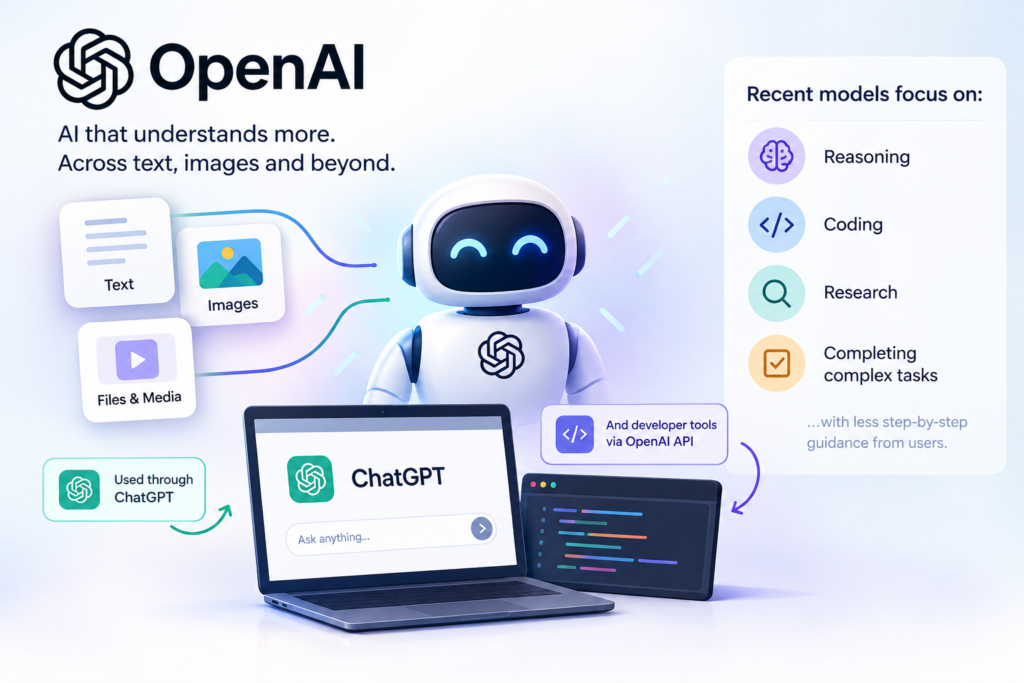
OpenAI develops AI models that can work with different types of information, including text and images. Its models are used through products such as ChatGPT and developer tools available through the OpenAI API. Recent models have increasingly focused on reasoning, coding, research, and completing complex tasks with less step-by-step guidance from users.
The scale of OpenAI’s technology is also significant. According to OpenAI, ChatGPT is used by more than 1 billion people every week as of August 2026, showing how quickly AI has moved from a specialized technology into a mainstream digital tool.
lets explore this blog with Marketing With Anshika
Why Is OpenAI Important in the AI Industry?
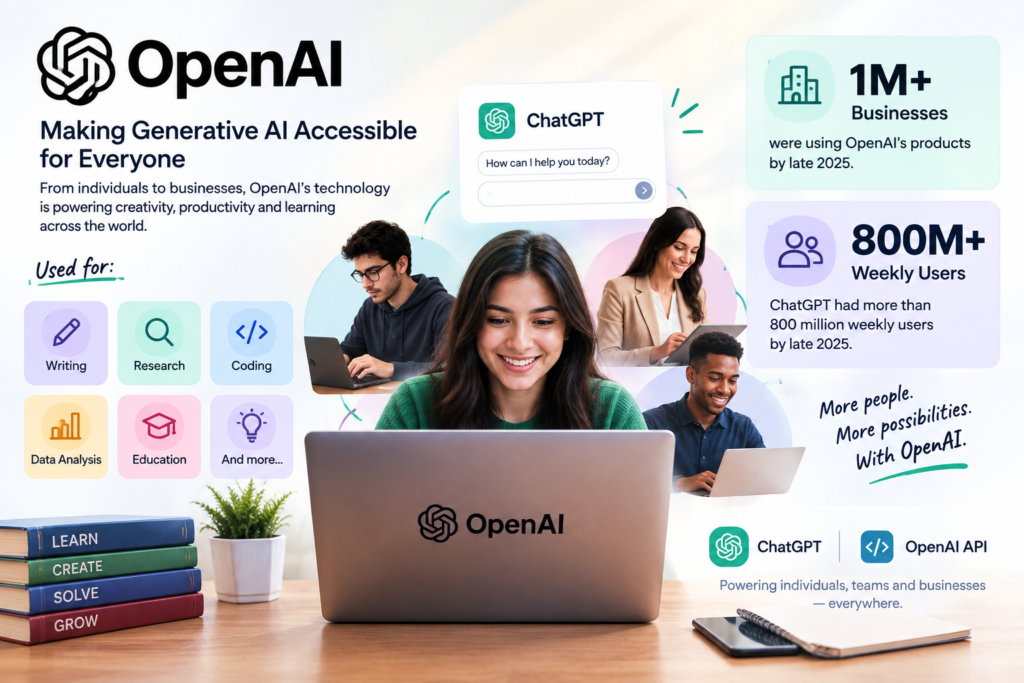
OpenAI has played a major role in making generative AI accessible to everyday users and businesses. Its technology is being used for writing, research, coding, data analysis, education, and other forms of knowledge work. OpenAI reported that more than 1 million businesses were using its products by late 2025, while ChatGPT had more than 800 million weekly users at that time.
[Resourse : https://www.podcastrepublic.net/
This growing adoption helps explain how OpenAI is changing AI: advanced models are increasingly being integrated into ordinary workflows rather than being limited to research laboratories.
lets explore this blog with Marketing With Anshika
Popular OpenAI AI Tools and Models
Some well-known OpenAI products and technologies include ChatGPT, GPT models, Codex, and the OpenAI API. ChatGPT provides an accessible interface for interacting with AI, while the API allows developers and businesses to integrate OpenAI models into their own applications. Codex focuses particularly on coding and software-development tasks.
As OpenAI continues developing more capable systems, questions such as “Is OpenAI changing the future?” and “Can OpenAI build human-level AI?” are becoming increasingly relevant. Its continuing research toward AGI is one reason OpenAI remains at the center of the broader AI conversation.
What Is AGI and Why Is OpenAI Focused on It?
Artificial General Intelligence, or AGI, refers to AI systems designed to handle a broad range of intellectual tasks at a human level rather than being limited to one specific function. OpenAI describes AGI as AI systems that are generally smarter than humans, while its research page describes the goal in terms of systems capable of solving human-level problems.
How Is AGI Different From Current AI?
Most current AI systems are highly capable but still operate within particular capabilities and limitations. They can write, analyze information, generate images, understand speech, or help with coding, but their performance can vary depending on the task. AGI is intended to be much more general: it would be able to learn, reason, adapt, and apply knowledge across many different areas.
This distinction is important when asking what is AGI. The goal is not simply to create a more powerful chatbot. Instead, AGI represents a broader concept of machine intelligence that can handle complex problems across different fields.
OpenAI now describes the path toward AGI as a series of increasingly useful AI systems rather than one dramatic moment when AGI suddenly appears. Its safety research says the company sees AGI as one point along a progression of systems with increasing capabilities.
Why Is OpenAI Focused on AGI?
AGI is central to OpenAI’s mission. The company says its mission is to ensure that AGI benefits all of humanity. OpenAI believes increasingly capable AI could contribute to scientific progress, productivity, education, and other areas, but it also emphasizes that greater capability brings greater responsibility.
In June 2026, OpenAI outlined three major goals: developing an AI system that can accelerate AI research, accelerating economic and scientific progress, and ultimately giving people access to personal AGI. The company also said it wants advanced AI to remain safe, aligned with human intent, and under human control.
This is why questions such as “Can OpenAI build human-level AI?” remain important. OpenAI’s own research describes its work as being on the path toward AGI, but the definition and exact point at which AGI is considered achieved remain important parts of the discussion.
For OpenAI, the development of AGI is therefore not only about making AI more capable. It is also about making increasingly powerful systems useful, safe, controllable, and broadly beneficial.
Is OpenAI Changing the Future of AI?
AI is moving from an experimental technology into a practical part of work, education, and everyday life. OpenAI is one of the companies contributing to this shift through tools such as ChatGPT and Codex. But is OpenAI changing the future? Current adoption data suggests that AI is already changing how people complete many tasks, although the long-term impact is still developing.
How AI Is Changing the Way People Work and Learn
AI can help people brainstorm ideas, summarize information, write drafts, analyze data, learn new topics, and support coding. OpenAI reported in August 2026 that people are more than twice as likely to use ChatGPT for completing tasks or creating something at work than outside work.
AI is also becoming part of learning. Students and learners can use AI to ask questions, understand difficult concepts, practice skills, and explore subjects at their own pace. OpenAI’s adoption research found that users tend to expand their use over time: six months after signing up, users in its 2026 sample sent 50% more messages per day and had tried twice as many distinct capabilities compared with their initial period.
How Businesses Are Using AI
Businesses are increasingly using AI for tasks such as marketing, customer support, software development, research, data analysis, and content creation. According to Stanford University’s 2026 AI Index, 88% of surveyed organizations reported using AI in at least one business function in 2025, while 79% reported regular use of generative AI in at least one function.
OpenAI has also reported significant workplace adoption. Its enterprise research found that weekly enterprise messages increased about 8× between November 2024 and 2025, while the average worker sent 30% more messages.
This shows how OpenAI is changing AI from a tool people simply ask questions to technology that can become part of larger business workflows.
The Growing Role of AI in Everyday Life
AI is increasingly being used for planning, writing, learning, research, creativity, and problem-solving. OpenAI reported that ChatGPT had surpassed 1 billion weekly active users by August 2026, illustrating the scale at which AI tools are being incorporated into everyday digital life.
So, is OpenAI changing the future? The evidence shows that OpenAI and the wider AI industry are already influencing how people work, learn, and interact with technology. What the full impact will be remains an open question, particularly as AI capabilities continue to develop.
Why Is OpenAI’s AGI Claim Important?
The discussion around OpenAI and AGI (Artificial General Intelligence) has become important because AI systems are moving beyond simple question-answering toward more complex reasoning, research, coding, and autonomous task completion. However, it is important to distinguish major AI capability milestones from a confirmed achievement of AGI.
What Does the AGI Claim Mean?
In simple terms, AGI refers to an AI system that can perform a broad range of intellectual tasks at a level comparable to, or beyond, humans. The challenge is that there is no universally accepted test or single definition that determines exactly when AGI has been achieved.
OpenAI has continued to describe its work as progress toward AGI rather than treating every new capability as proof that AGI has arrived. In September 2026, OpenAI said it had reached its goal of creating an “automated research intern” capable of completing well-defined research tasks under human direction, while targeting an automated AI researcher by March 2028.
Why Is AGI Considered Important?
AGI could represent a major change in how AI systems are used. Instead of being primarily tools for individual tasks, more general systems could potentially reason across different subjects, learn new tasks, conduct research, write software, and assist with complicated real-world problems.
Recent developments show why this discussion is becoming more serious. OpenAI’s latest frontier models have achieved very high results on several demanding benchmarks. For example, its GPT-6 Astra announcement reported a 99.9% score on ARC-AGI-3 and a 98% score on FrontierMath Tier 4. These results demonstrate substantial progress in specific capabilities, but benchmark performance alone does not establish that AGI has been achieved.
What Could AGI Mean for Future AI Systems?
If AI systems continue becoming more capable, they could increasingly assist with scientific research, software development, education, business operations, and other knowledge-intensive work. OpenAI recently reported that its researchers were already using AI agents extensively, with its research organization reaching 3.1 agent-workdays of effort for every human workday by mid-August 2026.
This raises an important question: Can OpenAI build human-level AI? The company is clearly pursuing increasingly capable systems, but the exact timeline and definition of AGI remain uncertain.
Has AGI Actually Been Achieved?
There are different views on this question because AGI does not have one universally agreed definition. Some people may consider human-level performance on a wide range of tasks sufficient, while others expect much broader abilities, reliability, adaptability, and autonomy.
Therefore, it is more accurate to describe current developments as rapid progress toward increasingly general AI capabilities rather than treating one benchmark or announcement as definitive proof that AGI has been achieved. OpenAI itself has emphasized that recent breakthroughs are milestones in an ongoing progression, not necessarily the final destination.
How Is OpenAI Changing AI?
OpenAI is helping move AI from a tool that mainly answers questions toward systems that can reason, create, research, code, and complete multi-step tasks. Its latest models are increasingly designed to handle complex work with less step-by-step guidance from users. OpenAI’s research describes this broader direction as part of its work toward AGI.
Development of Increasingly Capable AI Models
A major way OpenAI is changing AI is through the rapid development of more capable models. Its GPT-5.6 family, launched in July 2026, was designed for complex professional work, including coding, knowledge work, cybersecurity, and science. OpenAI also introduced GPT-6 Astra in September 2026, describing it as its most capable model for areas such as computer use, software engineering, science, and professional tasks.
The important change is not simply that models are getting larger or faster. Newer systems are increasingly able to plan tasks, use tools, work across software, and handle longer workflows.
AI for Writing, Research, Coding and Other Tasks
Today, OpenAI AI tools are being used across many types of work. ChatGPT can help with writing, information gathering, analysis, brainstorming, and document creation, while Codex focuses strongly on software development and coding tasks.
OpenAI reported that at work, people are more than twice as likely to use ChatGPT for completing a task or creating something than they are outside work. These uses include writing, coding, editing, and analysis.
Research is another growing area. OpenAI reported that approximately 1.3 million people use ChatGPT each week for advanced science and mathematics, generating around 8.4 million messages. Researchers use ChatGPT for ideas, knowledge gathering, hypotheses, communication, coding, and analysis.
How OpenAI Is Influencing AI Development
How OpenAI is changing AI is also visible in the shift from simple chatbots to AI agents. These systems can work on longer tasks, use different tools, and continue working toward a goal.
OpenAI reported that by May 2026, 70.2% of sampled Codex users had made at least one request estimated to require more than an hour of human work.
This shows a broader change in AI: instead of simply asking “What can AI tell me?”, people are increasingly asking “What can AI do for me?” As models become more capable, this shift could play an important role in how people work, create, research, and solve problems in the future.
Can OpenAI Build Human-Level AI?
The question “Can OpenAI build human-level AI?” is becoming more important as AI systems improve at reasoning, coding, research, and other complex tasks. OpenAI says its research is on the path toward Artificial General Intelligence (AGI), which it describes as a system capable of solving human-level problems.
What Does “Human-Level AI” Mean?
Human-level AI generally means an AI system that can learn, reason, adapt, and apply knowledge across a wide range of tasks at a level comparable to humans. Stanford HAI notes that there is no universally accepted test for AGI, partly because experts differ on what “human-level intelligence” should mean.
This means that simply performing extremely well on one benchmark does not automatically prove that an AI system has achieved AGI.
What Can AI Do Today?
Current AI systems have made substantial progress. Stanford’s 2026 AI Index reports that frontier models have surpassed human-level performance on some benchmarks, while AI agents have improved significantly at computer-based tasks. On OSWorld, for example, agent accuracy increased to 66.3%, compared with roughly 12% previously. However, agents still fail around one in three attempts on structured evaluations.
AI also shows what researchers call “jagged intelligence.” A system can perform extremely well on a difficult mathematical task while struggling with something that seems simple to humans. Stanford reports that one leading model achieved a gold-medal-level result at the 2025 International Mathematical Olympiad, while the best model correctly read analog clocks only 50.6% of the time, compared with 90.1% for humans.
What Challenges Are Involved in Developing AGI?
One major challenge is reliability. An AI system needs to perform consistently across unfamiliar situations, not just achieve impressive results in controlled tests. Another challenge is alignment—ensuring increasingly capable systems reliably follow human intentions and remain under meaningful human control.
OpenAI itself says it does not yet fully understand how capability, safety, and alignment will interact as systems become more powerful.
Why Is Achieving AGI Still Complex?
AGI is not simply about making a model better at answering questions. A genuinely general system would need to handle unfamiliar problems, adapt to new environments, reason reliably, and potentially work across long and complicated tasks.
OpenAI’s recent research shows progress toward this direction: the company says it has reached its goal of an automated research intern capable of completing well-defined research tasks that could take a skilled researcher several days. However, OpenAI also emphasizes that humans still set research priorities and decide which results to pursue.
So, can OpenAI build human-level AI? The company is clearly pursuing that goal, but current evidence shows a combination of major advances and important limitations. Whether and when AGI is achieved remains an open question.
Is OpenAI’s AI Helpful for People?
AI is becoming a practical tool for learning, working, researching, and creating. OpenAI’s AI tools such as ChatGPT can support people with tasks including drafting, summarizing, brainstorming, answering questions, coding, and analyzing information. OpenAI says these tools are designed to help people make progress, learn, and solve problems more efficiently.
How AI Can Help Students and Professionals
For students, AI can act as a learning assistant by explaining difficult concepts, providing practice, giving feedback, and helping learners explore subjects outside the classroom. A recent randomized experiment involving more than 1,000 students found that access to ChatGPT improved the quality and coherence of students’ work. Students still had to decide what to ask, evaluate the responses, and choose what to include in their final work.
For professionals, OpenAI AI can assist with writing, coding, research, analysis, and information retrieval. OpenAI’s 2026 workplace research found that people were more than twice as likely to use ChatGPT for completing tasks or creating something at work than outside work.
AI for Productivity and Creativity
One of the biggest advantages of AI is that it can reduce the time spent on repetitive or starting-stage tasks. A professional might use AI to create a first draft, organize ideas, summarize a long document, analyze information, or brainstorm campaign concepts. This can leave more time for tasks that require experience, creativity, and decision-making.
AI can also support creative work rather than simply automate it. Users can generate ideas, explore different approaches, improve drafts, and experiment with new concepts. OpenAI describes drafting, summarizing, and brainstorming as examples of tasks where ChatGPT can help people work more efficiently and creatively.
Benefits of Using AI Responsibly
The benefits of OpenAI’s AI depend heavily on how it is used. AI can save time, provide accessible learning support, and help people explore ideas, but its answers are not guaranteed to be correct. OpenAI recommends keeping a human involved in important work and checking critical information against trusted sources.
Why Human Judgment Still Matters
AI should support human thinking, not completely replace it. People need to evaluate whether an answer is accurate, relevant, unbiased, and appropriate for the situation. This becomes especially important for decisions involving education, finances, health, law, or other high-stakes areas.
Ultimately, is OpenAI’s AI helpful? It can be, particularly when people use it as a tool for learning, productivity, and creativity while keeping human judgment at the center.
What Could AGI Mean for the Future?If Artificial General Intelligence (AGI)
becomes possible, it could change how people work, learn, conduct research, and interact with technology. However, the exact impact is difficult to predict because AGI has not been universally defined or demonstrated as a finished technology. OpenAI describes its research as being on the path toward AGI, while current AI systems continue to have important limitations.
Possible Changes in Jobs and Workplaces
One of the biggest questions is how AGI could affect employment. AI is already changing individual tasks rather than simply replacing entire occupations. OpenAI’s 2026 research found that 43.5% of occupation-specific ChatGPT messages involved tasks associated with another occupation, suggesting that AI can allow workers to perform activities that previously belonged to different roles.
The effect on jobs is unlikely to be identical everywhere. Some roles could become more productive through AI assistance, while others could be reorganized as companies change how work is divided between people and AI. Stanford’s 2026 AI Index found that one-third of surveyed organizations expected AI to reduce their workforce during the following year, although large-scale job losses had not yet appeared across overall employment data.
Changes in Education and Research
AGI could also transform education by providing more personalized learning support. Students could potentially receive explanations, feedback, practice, and research assistance adapted to their needs. Already, four out of five U.S. high-school and college students report using AI for schoolwork, according to Stanford’s 2026 AI Index.
Research could benefit from AI systems capable of handling complex scientific tasks. OpenAI has announced programs providing frontier AI tools to researchers and says its systems are increasingly being used for scientific and mathematical work.
Potential Opportunities and Challenges
The potential opportunities include faster scientific discovery, increased productivity, personalized education, and new types of creative and technical work. At the same time, challenges could include job transitions, unequal access to AI, misinformation, safety concerns, and the need for new skills and regulations.
Why the Future of AGI Remains Uncertain
The future of AGI remains uncertain because nobody knows exactly when—or whether—AI will reach the broad, reliable capabilities associated with human-level general intelligence. Even current frontier systems can perform exceptionally well on some difficult benchmarks while struggling with other tasks.
Therefore, questions such as “Is AGI the future?” cannot yet be answered with certainty. What is clear is that AI development is progressing rapidly, and societies will need to adapt as these systems become more capable. OpenAI itself emphasizes that the development of advanced AI requires attention not only to capability, but also to safety, governance, and ensuring that its benefits are broadly shared.
Conclusion
The latest AGI discussion shows that OpenAI is pushing AI toward increasingly capable systems that can reason, use tools, conduct research, and handle complex tasks. OpenAI says it has reached its goal of building an “automated research intern” that can complete well-defined research tasks under human direction, including tasks that could take a skilled researcher several days.
At the same time, calling these developments AGI requires careful consideration. There is still no single universally accepted definition or test for AGI, so major advances in AI capability should not automatically be treated as proof that full AGI has been achieved.
OpenAI’s Role in AI Development
OpenAI’s role in AI development is centered on building increasingly capable models while also working on safety and alignment. Its latest GPT-6 Astra model demonstrates substantial progress across areas such as computer use, software engineering, science, and professional work.
OpenAI is also using AI to accelerate its own research. The company reported that, by mid-August 2026, its research organization was using the equivalent of 3.1 agent-workdays for every human workday, although OpenAI notes that these measurements are preliminary and do not mean research progress will increase at the same rate.
What Could the Future of AI Look Like?
The future of AI could involve systems that work alongside people across education, business, software development, science, and everyday tasks. More capable AI could increase productivity and help researchers tackle difficult problems, but it could also create new challenges involving safety, reliability, employment, governance, and human control.
OpenAI itself says that fully autonomous recursive self-improvement is not happening today and should not be pursued unless it can be done safely.
Ultimately, the question is not only “Is OpenAI changing the future?” but also how society chooses to manage increasingly powerful AI. The technology is developing quickly, while its long-term impact—and exactly when AGI should be considered achieved—remains uncertain.
